



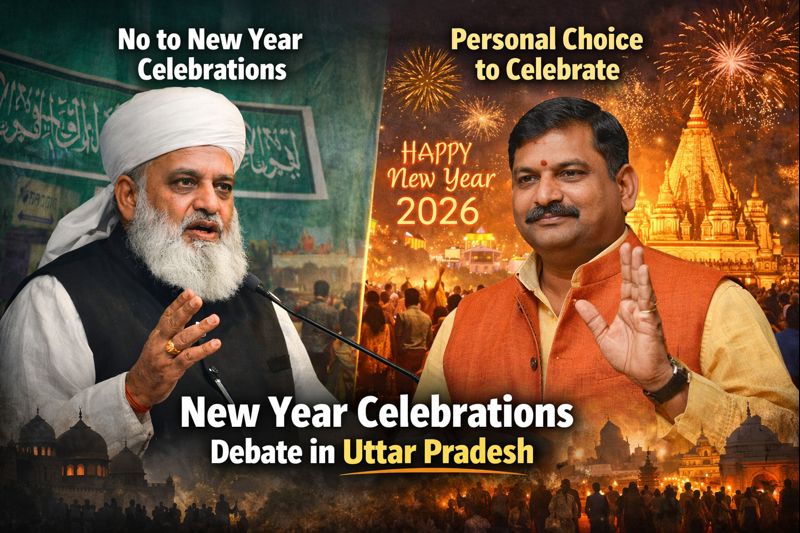
Uttar Pradesh Sees Public Discussion Ahead of New Year A debate has emerged in Uttar Pradesh after Maulana Shahabuddin Razvi Bareilvi, President of the All India Muslim Jamaat, advised against celebrating New Year’s Eve. His remarks, made ahead of December 31, sparked reactions from political leaders and the public, highlighting tensions between religious beliefs and
Uttar Pradesh Sees Public Discussion Ahead of New Year
A debate has emerged in Uttar Pradesh after Maulana Shahabuddin Razvi Bareilvi, President of the All India Muslim Jamaat, advised against celebrating New Year’s Eve. His remarks, made ahead of December 31, sparked reactions from political leaders and the public, highlighting tensions between religious beliefs and personal choice.
Jamaat Chief Opposes New Year on Religious Grounds
Islamic Perspective on January 1 Celebrations
Speaking in Bareilly, Maulana Razvi stated that celebrating December 31 often involves loud music, dancing, singing, and indulgence, which he described as frivolous and prohibited in Islam. He explained that such celebrations are inconsistent with the teachings of the Islamic Sharia and encourage unnecessary extravagance.
Cultural and Calendar Differences
The cleric emphasized that the Islamic New Year begins with Muharram, not January 1. He also noted that in Hindu tradition, the New Year starts in the month of Chaitra, pointing out that celebrations on December 31 hold no religious significance. Maulana Razvi warned that religious scholars generally prohibit excessive partying or revelry.
Political Leaders Stress Freedom of Choice
Minister’s Response in Lucknow
Uttar Pradesh Minister Dayashankar Singh responded, stating that celebrating New Year is completely optional. He clarified that January 1 is part of the English calendar, not India’s traditional calendars, and that everyone has the freedom to decide whether to observe it.
Additional Political Remarks
Singh also commented on a recent social media post by Congress leader Digvijaya Singh regarding the RSS and BJP. He highlighted that leadership growth in the BJP is merit-based, contrasting it with other parties, where dynastic politics often dominate decision-making.
Conclusion: Balancing Faith and Personal Freedom
The remarks and reactions illustrate the ongoing discussion in India on religious practices, cultural diversity, and individual choice. While religious leaders emphasize faith-based observances, government officials maintain that celebrations remain a personal decision, reflecting India’s pluralistic society.












Leave a Comment
Your email address will not be published. Required fields are marked with *